At Blank Bio, we've been building Ladon, our bulk transcriptomics foundation model. Our thesis is that bulk RNA-seq is now genuinely accessible in the clinic and offers an untapped source of rich biological signal that captures a patient's disease state. We are ultimately focused on how Ladon can learn patient heterogeneity to help scientists make better clinical trial decisions. Bulk transcriptomics is also the most abundant omics modality compiled for decades across cell lines, animal models, and humans, in nearly every corner of biology. That makes it a natural place to experiment broadly, and our next series of posts explores what the model learns and how it is useful for discovery, translation, and the clinic. Our first post is about AI agents for science, showing how we integrate our embedding-search MCP into Claude Science to surface disruptive, rather than incremental, hypotheses.
Sign up for early access to Ladon and get notified when we release the MCP.
Read this blog on Substack and subscribe to stay notified of future releases.
Imagining the same concept in new contexts
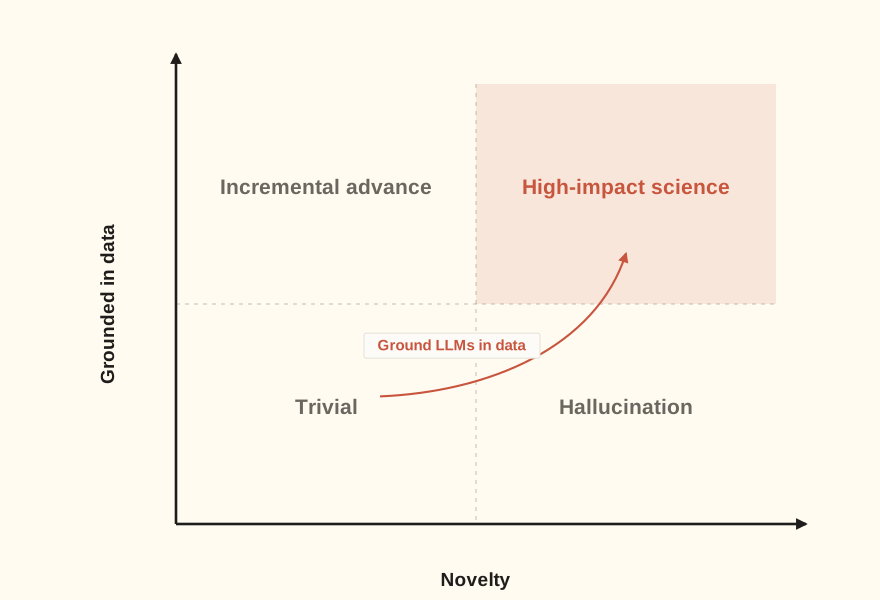
One of the most common ways scientists formulate hypotheses is by recognizing the same concept in a new context: a drug's effect reappears in an unrelated disease; a pathway that patterns the embryo shows up again in cancer; a mechanism worked out in yeast explains something in humans. Information science long recognized this could be systematized. A pioneering example was literature-based discovery, first formalized by Don Swanson, who in 1986 built a software tool that scanned two disconnected bodies of literature for shared words in their titles. Fast-forward forty years, and we now have LLMs that read entire papers faster and better than humans, tasked to link concepts across different contexts to generate a hypothesis. But text is one lossy representation of the raw data, and much of scientific data never makes it into published text. The open problem is designing AI that formulates disruptive, not just incremental, scientific directions.
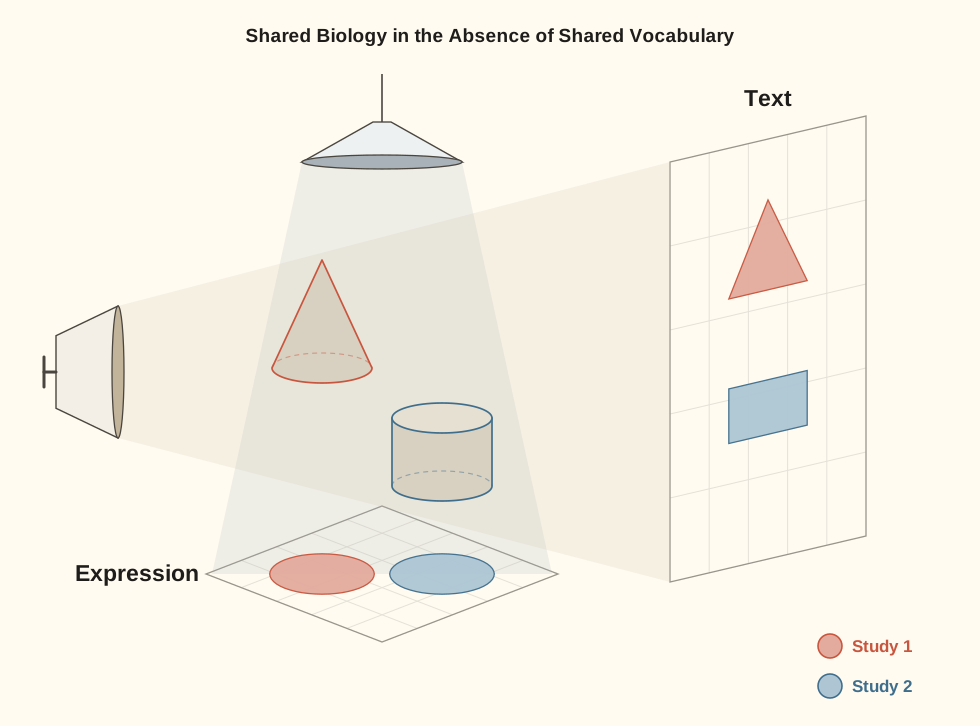
An alternative example of biologists systematically searching for cross-context concepts is apparent in genomics. Sequencing lets us read the state of a cell in tens of thousands of dimensions, providing a molecular fingerprint for a phenotype. To turn that fingerprint into a hypothesis, biologists query the gene list from an assay against curated gene sets to find keywords for literature search. But like text, a gene list is one possible representation of the raw data, and public ontological and gene set databases do not curate every concept. What comes back is rarely satisfying - always good enough to report cosmetic keywords that already fit the experimental design but often too generic for revealing insights or exciting surprises.
Querying the transcriptome universe
Is there a better representation of this high-dimensional data that captures biological concepts and makes the uncrowded, high-impact regions of hypothesis space easier to explore? This is one of our goals for building Ladon, a foundation model for bulk RNA-seq, built on millions of public samples spanning cell lines, mouse models, and human tissue across 20 years of experiments. Ladon learns an embedding that places each sample in a shared latent space where similar biology sit close together. The result is a map of biological states a user can query directly.
The existing transcriptome analysis pipeline reaches another study only after a chain of lossy hops: a thresholded gene list, then curated gene sets, then a keyword search of the literature. With an embedding query, your data lands in the latent space directly beside someone else's dataset, and the paper behind it. What makes this worth doing is what is already sitting in that map. A large share of public transcriptomics data is individual experiments where someone varied one element to isolate a biological program: a drug, a knockout, a single perturbation. Each is a concept captured directly in data, whether or not anyone curated it into a gene set or wrote it up as a finding. The map turns every one of them into something you can query.
A case study
To see what this can buy you, let's take a poorly understood disease. Myalgic encephalomyelitis - better known as chronic fatigue syndrome (ME/CFS) - affects millions, many housebound or bedbound for years, some unable to tolerate light or sound. It overlaps heavily with long COVID: both are post-viral, and a substantial fraction of long COVID patients meet ME/CFS criteria. ME/CFS is defined entirely by symptoms - no molecular diagnosis, no treatment, no curated signature.
On Claude Science, we re-analyzed a previously published RNA-seq dataset from skeletal muscles of ME/CFS and control patients. Claude called Ladon MCP, our embedding-based concept-search tool for agents, and instantly returned the dataset's neighbors in latent space. At the top, we saw a long COVID study whose authors reported just two differentially expressed genes. Even if it were curated, this dataset would have been impossible to match with a differential expression gene list.
But similarities in immune, vascular, and metabolic abnormalities are already well documented between ME/CFS and long COVID, unsurprisingly. To make this more interesting, we asked Claude to read the papers corresponding to the top 300 neighbors and triage them. Crucially, we did not prompt it to choose what makes the most sense but rather to eliminate them to focus on novel directions. We further asked it to prioritize perturbational over observational studies, and cells over tissues to bias for simpler cell-level concepts rather than complex, systems-level ones.
The goal here is to generate a list of candidates that provide one or two outliers that seed the next iteration of the research. Here's the shortlist of ~10 that it recommended:
| GSE | Sim | Perturbation | Biology tested | Theme | Species | Cell |
|---|---|---|---|---|---|---|
| GSE152329 | 0.901 | CCl4 (hepatotoxin) | liver fibrosis / injury | fibrosis | mouse | mouse liver (in vivo) |
| GSE148725 | 0.895 | benralizumab (anti-IL5Rα) | eosinophil / IL-5 immunity | immune | human | whole blood (asthma pts) |
| GSE270568 | 0.895 | docetaxel / cisplatin | polyploid stress survival | stress | human | MDA-MB-231, PC3 lines |
| GSE230362 | 0.886 | CDK7 inhibitor | CDK7 transcriptional addiction | proliferation | human | MCF7/T47D ER+ lines |
| GSE151159 | 0.886 | dasatinib (SRC/ABL) | glycolysis + immune activation | immune | human | primary CLL lymphocytes |
| GSE195571 | 0.882 | FOXA1 knockdown | hypoxia / HIF1A program | metabolic | human | prostate cancer line |
| GSE137851 | 0.882 | HOXB-AS3 lncRNA KD | ribosomal RNA transcription | RNA-processing | human | AML myeloblasts |
| GSE266333 | 0.878 | miR-134/433/487b | cardiomyocyte miRNA regulation | proliferation | human | iPSC-cardiomyocytes |
| GSE211200 | 0.876 | dyskerin (DKC1) KD | mRNA pseudouridylation / translation | RNA-processing | human | U2OS osteosarcoma |
As intended, these perturbants have no apparent tie to ME/CFS and come from unrelated contexts. What concepts could plausibly connect them to ME/CFS? One narrative we found attractive, from two of the highlighted studies: cellular senescence. Dasatinib is a leukemia drug, but it also clears senescent cells. Dyskerin is a core component of the telomerase complex, so it is critical for telomeres and thus senescence. Has anyone investigated cellular senescence as a potential mechanism for ME/CFS? No one yet has, but the hypothesis has very recently been proposed. The appeal is that known viral triggers can induce senescence, its persistence could explain the other abnormalities, and it points to potential interventions. So, explicitly through a data bridge, we reached a direction a domain expert had independently judged worth pursuing.
Where we are headed
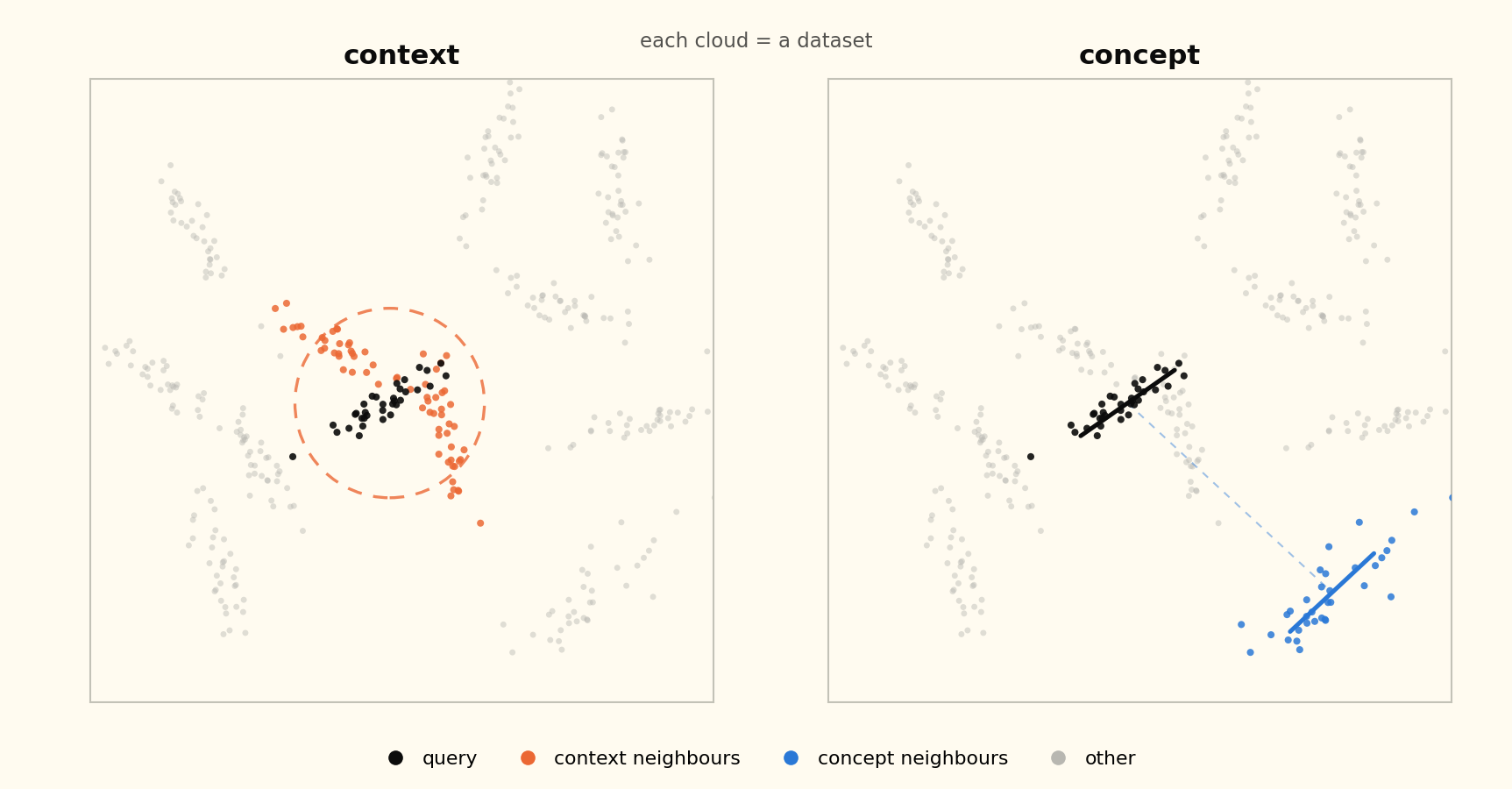
Absolute expression is dominated by context – cell line, tissue, species, batch – so a naive nearest-neighbor search returns more of the same context (like another muscle study), not the concept (a shared program like senescence). To query the concept, we match the geometry so that two studies in different contexts sharing the same biological program can be found. A key feature of our approach is that we do not require a contrast label: the match comes from geometry alone. Its limitation is the same: retrieval fails when the concept of interest is weak in that geometry, and a nuisance dominates instead. We are working on querying by variation along a specified contrast to better isolate the informative concepts from nuisance.
Another challenge we are working on is evaluation. Hypothesis quality has no ground truth that can be validated prospectively on a practical timescale. Retrospective benchmarks are just as hard - the task is high-sensitivity detection of rare positives against an effectively infinite negative space. Any "known" is both tiny and biased toward already-written. We cannot purely tune this offline - real-world scientist feedback is what will build and evaluate its usefulness.
Work with us!
A good hypothesis triangulates novelty, cogency, and reality, while an LLM has direct access to none of them. It can only thread them together through coherence, which is why asking it alone for a genuine surprise feels uneasy. One fix may be to ground the reasoning in a constrained space of concepts - letting it loose to read and triage at a scale no person can, but keeping it conditional on the data. We believe this could unlock immediate value from current AI for science to help accelerate disruptive research for everyone. If you're working with RNA-seq and want a searchable map over your own proprietary data alongside the public universe, we'd love to collaborate!
Sign up for early access to Ladon and get notified when we release the MCP.